



2026 Ford Bronco vs 2026 Toyota 4Runner
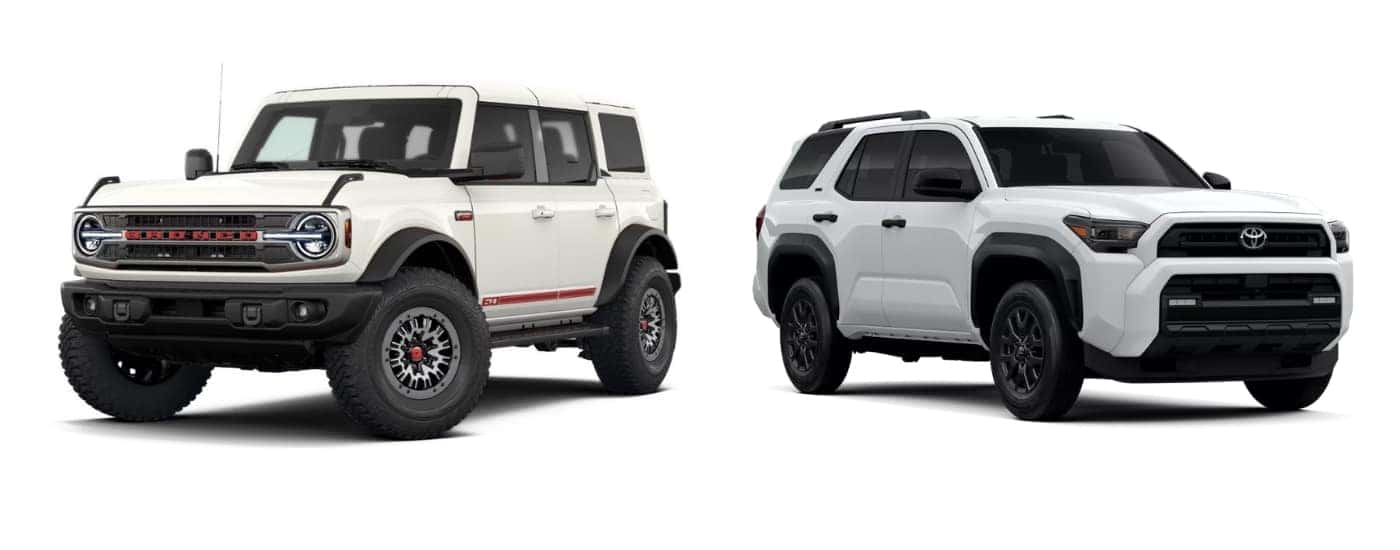
Adventure-seeking drivers searching for a vehicle that can handle the rigors of daily commuting and weekend getaways to the great outdoors have many options, thanks to the proliferation of terrain-capable compact and mid-size SUVs that offer excellent fuel economy and rugged construction. Many drivers refuse to settle for an SUV that is only dynamic on the pavement, as AWD-equipped vehicles that can roam beyond the beaten path have seen their demand swell in the last decade.
Fortunately, drivers can choose from a wide selection of off-road-capable SUVs, with many automakers vying for supremacy among drivers who split their time between urban environments and pursuits outside city limits. Two of the most outdoor-capable models also happen to be two of the most legendary, as the Ford Bronco and the Toyota 4Runner have developed devoted followings for their balance of terrain-tackling capability and refined urban driving performance.
If you’re comparing the 2026 Ford Bronco vs 2026 Toyota 4Runner, you should know that the Bronco offers superior off-roading capability, better technology across all trims, an iconic design, and more powertrain versatility at a lower price point. While personal preference is important, many drivers choose the Bronco for its legendary legacy, unique aesthetics, multiple engine options, and innovative off-road technology.
| 2026 Ford Bronco | VS | 2026 Toyota 4Runner |
|---|---|---|
| $40,495 [a] | MSRP | $41,870 |
| 418 | Horsepower | 326 |
| Standard | Four-Wheel Drive | Available |
| Yes | Removable Roof and Doors | No |
Exploring Engine Options
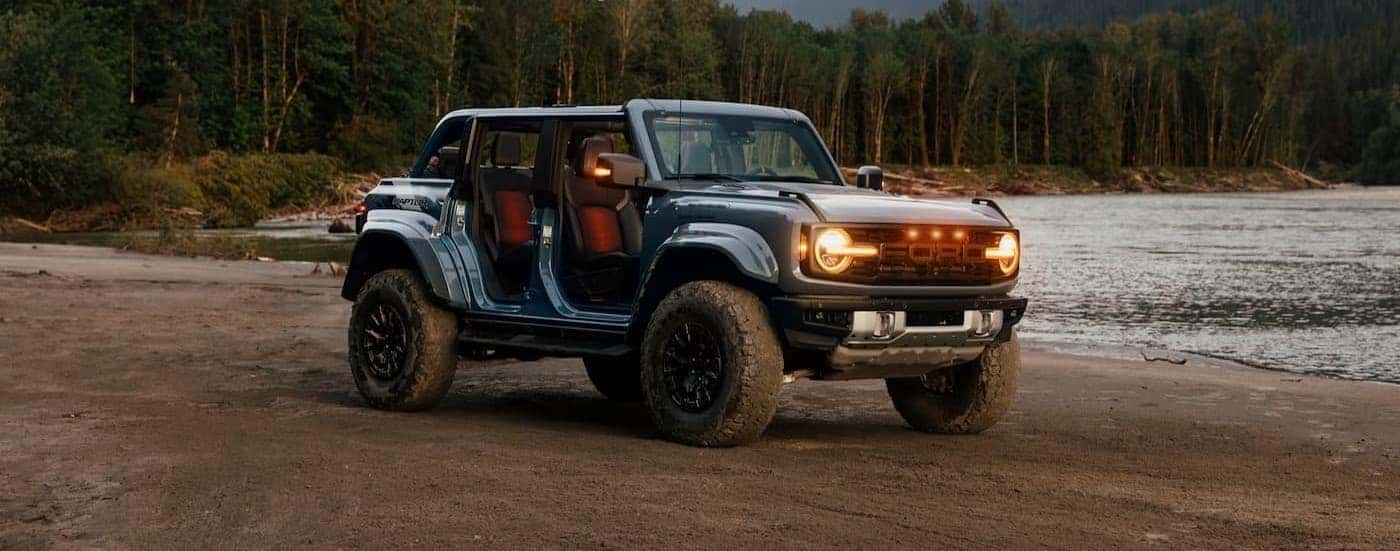
Both the Bronco and the 4Runner offer sufficient power for urban, suburban, and off-road driving. While the 4Runner offers a hybrid 2.4-liter turbocharged i-FORCE MAX inline 4-cylinder powertrain, there’s only one other gasoline-only engine option available. The Bronco, however, offers drivers three gasoline-only engine options, ranging from the efficient yet capable base 2.3-liter EcoBoost I-4 to the snarling 3.0-liter EcoBoost V6 found in the Raptor trim.
The Bronco Offers More Standard Power
The Bronco’s engine options have superior output across the lineup, as the base trim 2.4-liter EcoBoost produces 300 horsepower and 325 lb-ft of torque, besting the Toyota’s base trim 2.4-liter turbo i-FORCE I-4’s output of 278 horsepower and 317 lb-ft of torque. The Bronco also offers a 2.7-liter EcoBoost turbocharged V6 that generates 330 hp and 415 foot-pounds of torque.
The Bronco’s Superior Horsepower
The 4Runner’s top-tier 2.4-liter i-FORCE MAX hybrid powertrain delivers 465 lb-ft of torque compared to the 440 lb-ft produced by the Bronco’s 3.0-liter EcoBoost V6. However, the Bronco’s powerplant has superior horsepower output, beating out the i-FORCE MAX with 418 hp to the Toyota’s 326 hp. Across the board, the Bronco offers more powerful engine options, giving it better acceleration and reliable off-road ability without sacrificing fuel economy to a significant degree.
Four-Wheel Drive Is Standard in the Bronco
Another consideration for off-road-obsessed drivers is that every Bronco comes with at least part-time 4WD, while higher trims incorporate Ford’s innovative advanced 4WD with a dual-clutch rear drive. Though higher trims of the 4Runner also feature 4WD, the drivetrain is optional in lower 4Runner trims. Also, the Bronco has a standard 10-speed automatic transmission, while the 4Runner has an eight-speed automatic transmission. Only the Bronco offers a manual shift option: a seven-speed standard transmission that delivers incredible control and responsiveness.
Given the versatile powertrain options, better horsepower and torque output across more trim levels, standard 4WD, and the option of a manual transmission, it’s easy to see why many drivers consider the Bronco to be the superior choice for off-road performance and on-road stability and efficiency.
Which Model Offers More Off-Road Prowess

When the city lights melt into the darkness of the wilderness, and the pavement gives way to dirt and gravel, the Bronco truly shines compared to the 4Runner. The 4Runner is a rugged and capable overlanding machine, but the Bronco’s design and specialized systems allow it to best the iconic Toyota when the road gets rough and obstacles abound.
Unlike the 4Runner, the Bronco is built for navigating rough terrain, with its design optimized for both on-road performance and terrain-conquering capability. Its shorter wheelbase provides a tighter turning radius, making it adept at three-point turns on city streets and at navigating around obstacles on backcountry trails.
The Bronco’s Trail Turn Assist
It also has better approach and departure angles than the 4Runner, allowing it to climb uneven driving surfaces without getting hung up. The available Trail Turn Assist in the Bronco also gives it a maneuverability edge over the 4Runner. During tight turns, it applies brake force to the inside wheels, causing the vehicle to pivot around the inside for ultra-tight, low-speed turns on loose surfaces like sand and gravel.
The Bronco’s H.O.S.S. System
Another all-terrain-friendly feature on the Bronco is the excellent H.O.S.S. system, standard equipment. The H.O.S.S. acronym stands for “high-performance off-road suspension system,” and one of three versions of the innovative off-road feature is included on every Bronco as standard equipment. To get tuned suspensions and improved articulation in the 4Runner, drivers must opt for an off-road-focused or upper trim level, which also comes with an elevated price tag.
Depending on the H.O.S.S. level, Ford’s system may include independent front suspension, Bilstein or Fox dampers, and features designed to increase articulation so wheel surfaces remain on the ground on uneven driving surfaces. Similar equipment with top-tier components, such as Bilstein and Fox dampers, is only available on the upper 4Runner trim levels.
You’ll Find More Drive Modes on the Bronco
Both models feature a drive mode selector that lets drivers tune their vehicles’ settings to better match changing driving conditions. The 4Runner’s DMS selector includes Eco, Normal, and Sport modes, with additional drive modes like Comfort, Sport S, Sport S+, and Custom modes added only in top trim levels.
The Bronco includes Ford’s incredible G.O.A.T. system, which stands for “goes over any terrain.” All Broncos are equipped with at least 5 G.O.A.T. modes, including Normal, Eco, Sport, Slippery, and Sand, giving the Bronco better control over a variety of on-road and off-road driving conditions. Upper trims add off-road-intensive modes like Mud/Ruts, Baja, Rock Crawl, and Tow/Haul.
With more innovative off-road features and all-terrain systems in place, the Bronco once again tops the 4Runner as an all-terrain machine capable of chasing adventure wherever it may lead. While the 4Runner is comfortable and capable in overlanding conditions, only the Bronco has the rock-crawling, creek-fording, and sand-scouring capability to go almost anywhere without fear of getting stuck.
Infotainment and Driver Assistance Tech
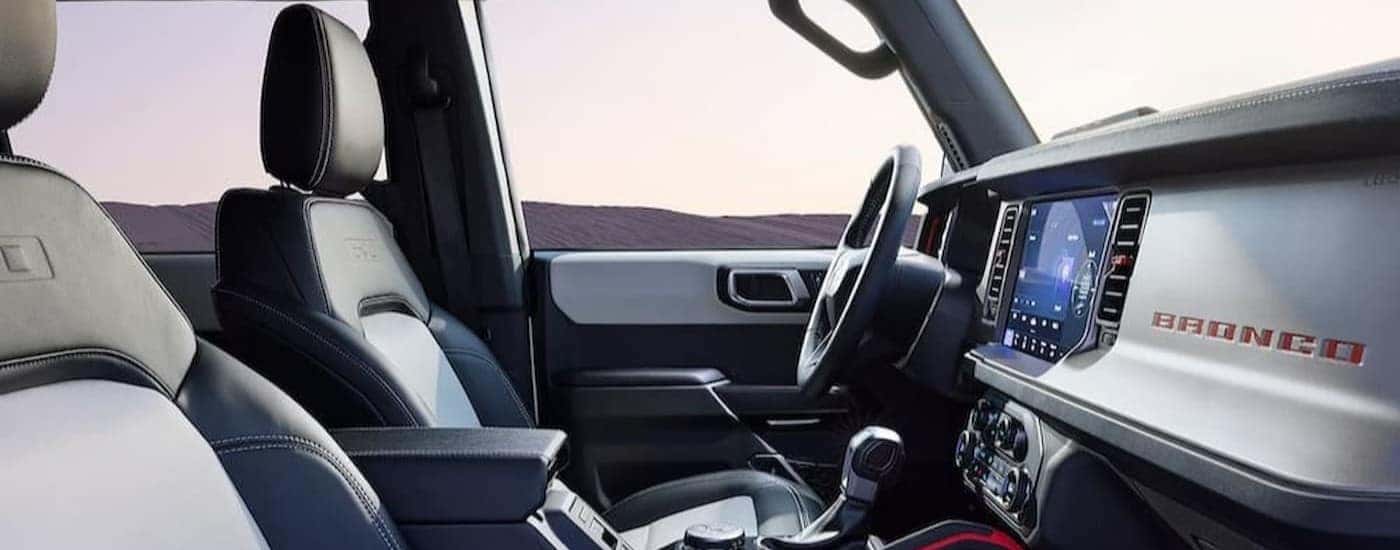
Even though the Bronco is built for rugged conditions and terrain-tackling capability, it also bests the 4Runner in terms of top-tier standard infotainment and driver assistance technology. Both vehicles have the latest available technology from their respective manufacturers, but the Bronco provides drivers with better tech as standard equipment across most trim levels.
A Larger Standard Touchscreen on the Bronco
For example, the Bronco’s standard equipment includes a 12-inch touchscreen on all trim levels, along with a matching 12-inch digital instrument cluster that provides line-of-sight information and excellent visibility. The standard screens on the 4Runner include an eight-inch touchscreen display, with a 14-inch display available only in the highest trim levels. The 4Runner’s standard digital instrument cluster is a seven-inch display, with a 12.3-inch cluster available on upper trim levels.
The Bronco’s infotainment platform is driven by the SYNC 4 software with integrated Apple CarPlay and Android Auto. It also has standard enhanced voice recognition and in-car Wi-Fi. The 4Runner includes the Toyota Audio Multimedia system, which also has voice recognition and Wi-Fi service. However, Toyota’s Wi-Fi service relies on a subscription to the automaker’s Wi-Fi Connect service powered by AT&T.
Examining Safety and Driver Assistance Feature
In terms of driver-assistance technology, both the Bronco and 4Runner offer reliable, proven features such as automatic emergency braking, forward collision warning, and lane-keeping assist. Ford’s Co-Pilot360 suite is included with every Bronco trim level, and Toyota’s Safety Sense 3.0 offers a traditional lineup of safety and risk mitigation features.
What separates the two is the Bronco’s off-road-focused driver assistance features, such as Trail Control, which acts as cruise control for low-speed off-road travel. While that may not matter for the average urban driver, those who frequently enjoy pursuits beyond the pavement appreciate those added driver assistance amenities.
A Closer Look at Exterior and Interior Design

Again, the Bronco is built to split time between civilization and the great outdoors, so its design reflects that duality with functional elegance. While the 4Runner looks like many other two-row mid-sized SUVs on the market, the Bronco has a unique style that won’t be confused with any other vehicle. Its boxy design, corner-positioned wheels, and high roofline give it an advantage over the 4Runner on the road and off.
The Bronco Has a More Versatile Design
With wheels positioned at the corners, the Bronco has greater on-road and off-road agility than the longer 4Runner. The shorter overall length of both the two-door and four-door Bronco gives it better maneuverability when traveling narrow city streets, tight suburban parking lots, and pinched backwoods trails.
The Bronco’s More Passenger-Friendly Cabin
The higher top also gives the Bronco more cabin space for increased comfort. The Bronco offers more headroom and legroom than the 4Runner in both the front and rear rows, making the Bronco’s cabin more passenger-friendly. The Bronco offers intuitive controls that are easy to read and reach, and it uses higher-quality materials at lower trim levels than the 4Runner, further enhancing the Bronco’s welcoming cabin.
Enjoy the Open Air With the Bronco’s Removable Roof and Doors
The most obvious design difference between the two SUVs is the Bronco’s open-air capability. While the 4Runner is built as a traditional SUV with a hard, non-removable roof, the Bronco offers drivers the ability to open up the cab to let the sun shine in. The Bronco’s roof panels and doors are easily removed when the weather allows, so drivers can enjoy pleasant temperatures and the wind in their hair no matter where their travels take them. With both hard-top and soft-top modules, the Bronco is built to allow fun in the sun, a capability the 4Runner simply can’t replicate.

The Bronco Lets You Chase Adventure Anywhere
Whether your life consists of daily commutes across the city, suburban errand-running, or weekend getaways that stray far from civilization, the Ford Bronco offers a wide range of capabilities that the Toyota 4Runner simply can’t match. While the 4Runner is well-suited for city life with occasional light recreational overlanding, only the Bronco is built to tackle the toughest terrain so that drivers can roam wherever adventure leads.
The Bronco also offers more advanced standard features than the 4Runner, delivering better value without sacrificing capability, power, or efficiency. For drivers seeking a vehicle that can split time between city life and outdoor pursuits beyond the beaten path, the Ford Bronco may just be the perfect vehicle.
