



Comparing the F-150’s PowerBoost Hybrid Engine to the F-150 Lightning’s All-Electric Performance
The old maxim “don’t mess with success” might sound like logical advice, but resting on your laurels is a surefire way to get left behind in today’s ultra-competitive auto industry. With impressive technological advances making their way to the market with every passing model year, even America’s best-selling vehicle needs to learn a few new tricks to maintain its position atop the charts.
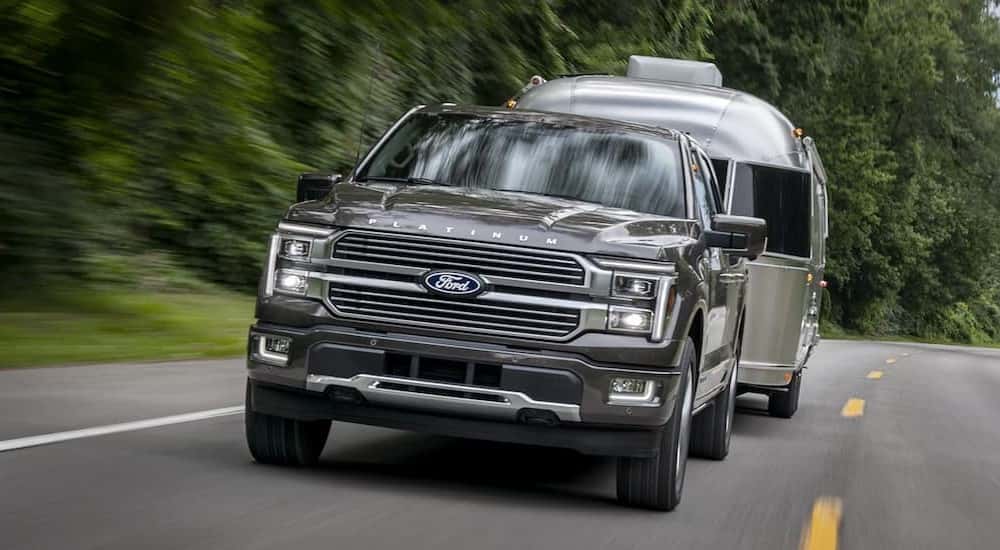
Ford has taken a double-pronged approach to innovation with the popular F-150 pickup, introducing both an all-electric version and a hybrid model in recent years. The F-150 with the PowerBoost engines combines that traditional gas engine with an electric motor to maximize efficiency, while the F-150 Lightning EV forgoes the engine altogether to provide an electrifying experience that you won’t soon forget.
It’s an exciting time to consider buying a new Ford F-150 for sale near Troy, but the new slate of powertrains also raises some questions. What are the main differences between hybrid and EV tech? How are they similar, and what sort of unique advantages can drivers unlock by embracing the new generation of electrified pickups? We’ll answer all that and more as we dive into the battle between the F-150 PowerBoost hybrid and the Lightning EV.
What Is a Hybrid Vehicle?
Before we launch into an in-depth comparison between the F-150 PowerBoost hybrid and F-150 Lightning EV, we should cover some of the basic differences between hybrids and electric vehicles (EVs). We’ll start with hybrids, which, as the name implies, leverage both a traditional gas-powered engine and an electric motor to push the F-150 pickup down the road.
The electric motor typically serves to supplement the gas engine, kicking in to improve the truck’s performance and fuel efficiency while also opening up the door to onboard power generation. To complicate things further, there are two distinct types of hybrids on today’s market. The F-150 PowerBoost is what’s known as a full hybrid, which offers some important cost- and convenience-related benefits when compared to a plug-in hybrid vehicle (PHEV).
While a PHEV needs to be plugged into a power source to replenish the battery, a full hybrid like the F-150 PowerBoost is constantly topping off the battery using both the gas engine and a clever regenerative braking feature that essentially turns the hybrid’s electric motor into a generator.
By capturing the energy that would otherwise be wasted when coasting or braking, the regenerative braking system is able to keep the hybrid battery all charged up and ready to go. It’s also a little easier to acclimate to a full hybrid if you’re coming from the world of internal combustion, as Troy drivers won’t have to worry about plugging in their pickup overnight or making a pit stop at a charging station during a long road trip.
If there’s one downside to a full hybrid over a PHEV, it would be the lack of electric-only range. Most PHEVs can travel between 30 to 40 miles on battery power alone, but the F-150 PowerBoost needs a little gas in the tank if you want to get anywhere.
This drawback aside, it’s easy to understand why Ford opted for the full hybrid approach over a PHEV design. The full hybrid provides many of the efficiency-related benefits of a hybrid without asking owners to drastically change their driving habits while still delivering the sort of performance we’ve come to expect from the storied F-150.
A Look at How All-Electric Vehicles Operate
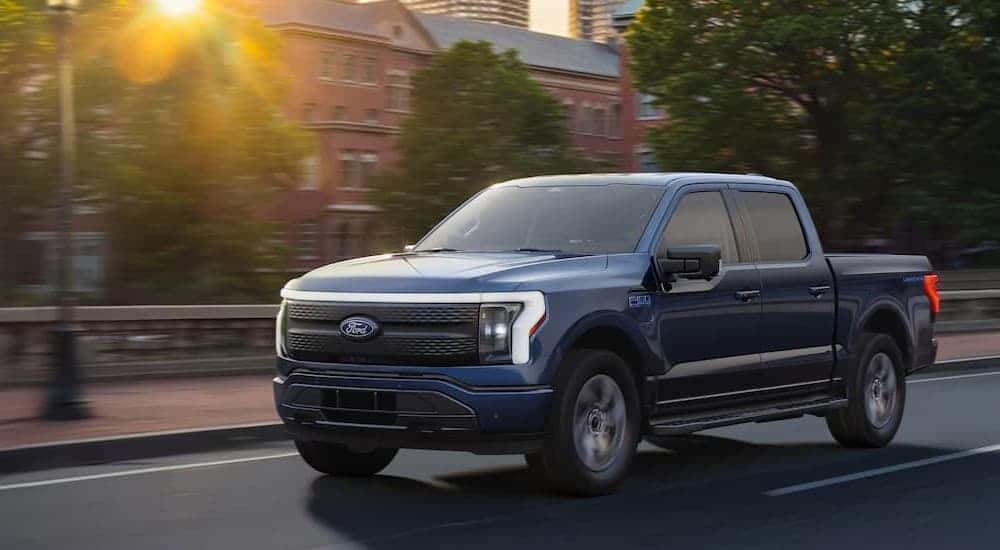
All-electric vehicles might seem like a recent innovation, but the technology actually dates as far back as the late 1800s. EVs have come a long way in the last 100-plus years, and now represent some of the fastest vehicles on the road with models like the F-150 Lightning offering a blistering zero-to-60-mph speed of four seconds.
In many ways, an EV is a little easier to understand than a full hybrid or PHEV. Instead of a gas engine, EVs use a large battery pack and an electric motor to provide all the propulsion you’ll need. Larger EVs like the F-150 Lightning typically employ at least two electric motors, which, in addition to upping the performance potential, also means that all-wheel drive is included as a standard feature. AWD can be a valuable addition to any vehicle, especially one tasked with dealing with the snowy winter weather that’s all too common in Troy.
The F-150 Lightning stores power in a 131-kWh lithium-ion battery pack in the form of direct current (DC) electricity. An integrated inverter converts this DC power into the AC energy for the electric motors, which spin up to speed to provide miles of eco-friendly power. Like hybrids, EVs use regenerative braking to capture excess energy when the opportunity arises, feeding it back to the lithium-ion battery pack and keeping the F-150 Lightning moving along.
While this helps to extend the F-150 Lightning’s range, drivers will still need to treat the truck to a nightly charge if they want to enjoy its full 320-mile driving range. Luckily, the EV is a model of efficiency, charging the battery from 15 to 80 percent in just under 45 minutes when connected to a public DC fast-charging station.
Comparing the Performance of These Two F-150 Models
The F-150 Equipped With the PowerBoost Hybrid Engine
Ford has set the hybrid F-150 up for success with a cutting-edge powertrain that combines the best of both the gas and electric worlds. A turbocharged 3.5-liter V6 and an electric motor deliver up to 430 hp and 570 lb-ft of torque. This last number is especially intriguing as it means that the hybrid F-150 is actually the most torque-heavy model in the current lineup outside of the unhinged off-road machine that is the F-150 Raptor R.
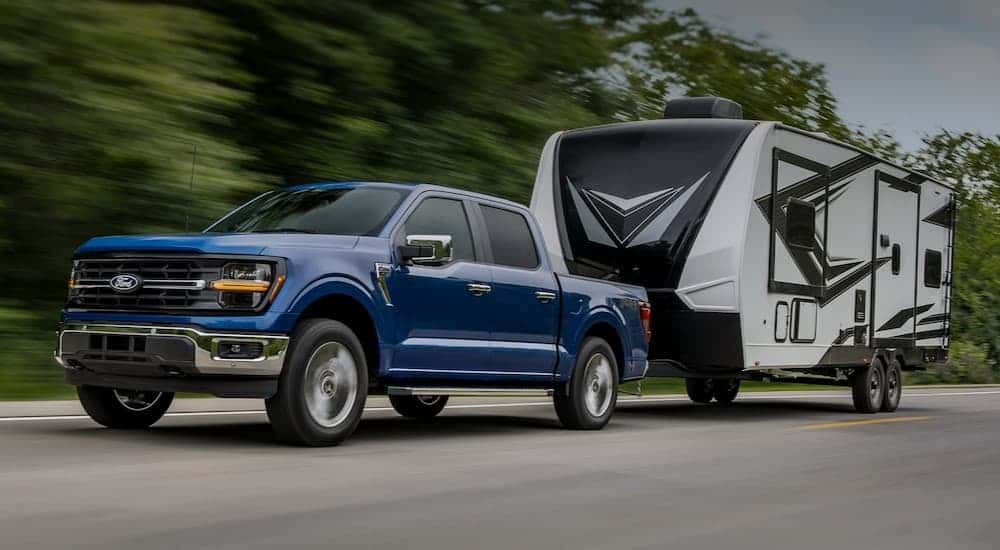
Torque also translates directly to pulling power, which is good news for any driver looking to do some serious towing or hauling behind the wheel of an F-150 hybrid. The PowerBoost engine also offers an impressive 11,200-lb maximum towing capacity.
The F-150 hybrid certainly maintains the truck’s reputation for performance, but it’s the efficiency-related benefits that really set the PowerBoost apart from its gas-powered brethren. The hybrid gives drivers the ability to travel more than 800 miles on a single tank of gas. That’s significantly further than the traditional V6 and V8 models, which typically top out at between 391 and 483 miles.
The argument for the hybrid becomes even more convincing when you look at the pickup’s fuel economy, with the F-150 returning an EPA-estimated 23 MPG combined as opposed to 20-21 MPG for the V6 engines and 19 MPG for the V8. The F-150 hybrid will also allow drivers to get their kicks with a zero-to-60-mph time of five seconds. The V6 model isn’t too far behind at 5.3 seconds, but the hybrid easily outpaces the V8 that takes around six seconds to hit the same speed.
The F-150 Lightning’s Electrified Performance
The F-150 Lightning’s all-electric design brings some substantial benefits in terms of performance. Every model is equipped with the same two-motor setup and all-wheel drive, but it’s the size of the battery that really determines the amount of power the pickup can produce.
When equipped with the 98-kWh Standard Range battery, the Lighting tops out at around 452 hp. That’s more than all but the Raptor and hybrid versions of the regular F-150, which just goes to show the potential behind the electric powertrain. Opting for the 123- or 131-kWh Extended Range battery sees the Lightning’s output increase to 536 hp for the Pro and Flash trims and all the way up to 580 hp for the Pro, Lariat, and Platinum models.
The torque stats are the same across the board, with every F-150 Lightning providing 775 lb-ft. However, upgrading the battery can make a big difference when it comes to towing power. The Standard Range battery leads the way in payload capacity at 2,000 lbs, but maxes out at 7,700 lbs in the towing department. The Extended Range batteries solidify the Lightning’s workhorse credentials with 10,000 lbs of max towing capacity, which makes the larger option an obvious choice for those looking to put in a little overtime.
As we mentioned above, the Lightning’s electric motors offer the sort of instant acceleration that would put some sports cars to shame with a zero-to-60-mph time of four seconds. The Lighting tops out at 110 mph, and could probably eclipse that number if not for the presence of a built-in governor.
The F-150 Lightning provides drivers with between 240 and 320 miles of range, depending on the battery, and the truck can be easily recharged using a standard 110- or 220-volt home connection. If you need to add a little range mid-trip, a quick visit to a DC fast-charging station can work wonders, but how does the EV stack up against the average full-size pickup?
It’s tough to compare the apples that are gas-powered vehicles to the oranges that are today’s EVs, but luckily, experts have developed a handy MPG-equivalent (MPGe) metric that helps to put efficiency in perspective. The Lightning delivers 76 MPGe in the city and 61 MPGe on the highway when equipped with the Standard Range battery, and 78 MPGe in the city and 63 MPGe on the highway for the Extended Range version.
These numbers might seem a little backwards to those who are more familiar with the internal combustion approach, but it largely comes down to a matter of aerodynamics and regenerative braking. Moving through Troy at higher speeds on Route 4 can create a lot of drag as the wind pushes against the vehicle, and also doesn’t provide many opportunities to engage the brakes in a way that would activate the regenerative braking feature.
DePaula Ford Is Your Source for Hybrid and EV F-150 Pickups
The F-150 PowerBoost and the F-150 Lightning differ in some important ways, but they do share one enticing feature that has a big impact on the pickups’ overall value and utility. Both models offer a unique Pro Power Onboard feature that essentially allows the trucks to serve as an impromptu power source.
Need to power some crucial camping equipment or keep your refreshments cool during a long day at the beach? Bed-mounted outlets will deliver all the power you need for even the most ambitious tailgate. The Pro Power Onboard feature can also prove valuable should you lose power during one of Troy’s winter storms, providing between 7.2 kW and 9.6 kW of power that can meet the average home’s electricity needs for up to three days.
The Ford F-150 PowerBoost hybrid and the all-electric F-150 Lightning represent nothing less than a revelation in the full-size pickup segment. Ford has managed to artfully employ some of the industry’s most exciting hybrid and EV tech without sacrificing performance to create a well-rounded set of trucks that rule the roost in terms of efficiency.
The hybrid and EV approaches each have their pros and cons, and while we’ve tried to give a basic overview of the differences between the two technologies, we’re always happy to answer any questions you might have when you stop by DePaula Ford. Whether you need a reliable new work truck that handles the demands of the jobsite, a comfortable daily driver that’ll lower your annual fuel costs, or a dependable family vehicle that’s helping to create a greener planet for the next generation, the Ford F-150 PowerBoost and F-150 Lightning are here to serve.

0 comment(s) so far on Comparing the F-150’s PowerBoost Hybrid Engine to the F-150 Lightning’s All-Electric Performance