



All About the Ford Bronco

Ford has a long history of producing very capable off-road SUVs, and the most famous of these is the Ford Bronco. Although this model was out of production for many years before being reintroduced for the 2021 model year, it remains one of Ford’s most iconic SUV models ever. And while the new Bronco is a highly capable vehicle in its own right, its predecessors have left it a considerable reputation to uphold. So if you are currently searching, “new car dealerships near me,” trying to find a new Bronco or even another one of Ford’s SUV models, stop and take a moment to catch up on the history of the earlier generations of Ford’s most classic SUV. And once you have learned more, consider stopping by DePaula Ford in Albany, NY. But let’s not get ahead of ourselves, first, here is more on the Ford Bronco.
Today, the term SUV has largely come to mean any four-door hatchback with higher than average ground clearance. And with the increasing rise of subcompact front-wheel drive SUVs, even this vehicle type’s former attribute of better than average off-road and lousy weather performance has largely disappeared. However, when the term SUV was first introduced in the 1960s, this was not the case. The early SUVs lived up to their title by being utilitarian two-door vehicles intended for off-road sporting activities. These included the Jeep CJ, the International Harvester Scout, and the Ford Bronco. Over its history, the Bronco increasingly moved away from that model and became more road-oriented, before eventually being replaced by the more comfortable Ford Explorer. However, the more recent explosion of popularity for SUVs has reopened a niche in the Ford lineup for a more off-road capable vehicle, giving the Bronco a new lease on life.
The Legend Begins
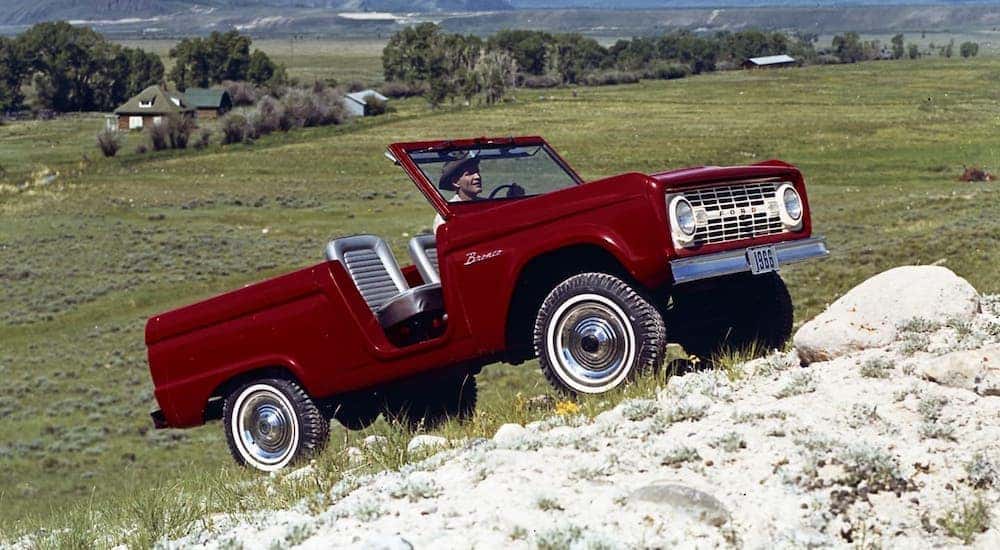
The original Ford Bronco was first introduced in 1966 and was a bare-bones utility vehicle. Its dedicated platform included two solid axles and coil spring suspension, giving it a combination of ruggedness and good handling that was perfect for its intended role. And although it came with two doors in all its variants, dealers offered the first-generation Ford Bronco as a hatchback, a half cab pickup, or a roofless roadster, giving it remarkable flexibility. Engine options for this early SUV were rather capable with the choice between either a 2.8L straight-six or a 4.7L V8, although the only transmission option was a three-speed manual. Over the years, the Bronco received additional powertrain options, including an automatic transmission and larger 3.3L and 4.9L engines, making it an even more capable vehicle.
But while the Ford Bronco was an excellent vehicle for a wide range of uses, it made its name in off-road racing. One of the racing teams sponsored by Ford got early access to the Bronco and began racking up wins even before the new SUV was widely available at dealerships. Among these victories were first-place finishes in prestigious races such as the Mint 400, Baja 500, and Baja 1000. And to commemorate its vehicles’ success, Ford produced limited numbers of Baja Broncos wearing a paint scheme inspired by the livery of the racing team.

The Next Generation
Although the original Ford Bronco had been a compact vehicle that was close to the Jeep CJ in both size and purpose, for the second generation, Ford decided to go larger in order to compete with more comfortable competitors such as the Jeep Cherokee and Chevy Blazer. Based on the Ford F-100 pickup, the wheelbase of the new Bronco was extended from just 92 inches to 104 inches, and the overall length grew from 151 inches to 180 inches. The Bronco also lost its more utilitarian body styles and was now available only as a hardtop hatchback, although the rear half of the cab was made of fiberglass and was removable. Finally, the older engine options were dropped in favor of much more powerful 5.8L and 6.6L V8s.
But while it was far more comfortable and capable than the original Ford Bronco, the second generation of the vehicle was not particularly successful. Although work began on this vehicle in 1972, with a planned 1974 model year release that would follow the 1973 introduction of the related F-100 pickup, Ford’s schedule was overtaken by events. In 1973, OPEC declared an oil embargo and kicked off a multi-year energy crisis that left little market interest in V8 SUVs. And rather than fill up Ford dealership lots with new cars that no one wanted, the second generation Bronco was delayed for four years before its eventual release as a 1978 model year vehicle. Although the new Bronco was popular when it finally hit the market, Ford was already working on a more suitable third generation.
Third Time’s the Charm
After an incredibly short two-year production run, the second generation Ford Bronco was replaced for the 1980 model year by an all-new vehicle. Based on the new 1980 F-150 pickup, the 1980 Bronco was outwardly remarkably similar to the second-generation SUV. However, under the hood, there were some mechanical differences. Most obviously, the massive 6.6L V8 engine was dropped in favor of a more efficient straight-six engine reminiscent of the first-generation Bronco. However, unlike the original off-road vehicle, the third generation Bronco replaced the solid front axle with a more road-friendly independent front suspension. These changes put the Ford Bronco back on the right path, and it sold well throughout its seven-year production run.
The fourth and fifth generations of the Ford Bronco were introduced for 1987 and 1992, coinciding with new generations of the F-150 pickup. However, they were mostly unchanged from the pattern set by the third generation Bronco. The dimensions and even engine sizes of these SUVs went effectively unchanged until the last Ford Bronco rolled off the line in 1996. The only significant difference was that the fifth-generation SUV permanently attached the rear half of its cab, removing the last trace of the Bronco’s utilitarian nature. It was clear by that point that there was little interest remaining in truck-based two-door SUVs, and for the 1997 model year, the Bronco was replaced on dealership lots with the all-new four-door Ford Expedition. With much greater comfort and more car-like features, the introduction of the Expedition marked the end of the line for Ford’s original SUV.
DePaula Ford
Now that you know a little more about the Bronco, consider stopping by DePaula Ford. We have a full lineup of new Ford cars, trucks, and SUVs, as well as an unmatched inventory of quality, used vehicles of all makes and models. As the number one Ford dealer in upstate New York for three years running, there is no better place to find the Ford of your dreams. Whether you are a long time Ford owner or if you are new to these great American vehicles, our friendly and knowledgeable sales team will be happy to acquaint you with all of the features of whatever model has caught your eye.
And if you like what you see, then we offer highly competitive pricing and unbeatable financing terms. Further, our service department is one of the best around, and we will keep your purchased vehicle running to factory specifications for years to come. There are so many things to be excited about at DePaula Ford. So give our dealership a visit and, in the near future, possibly become the latest participant in the Ford Bronco legend.

0 comment(s) so far on All About the Ford Bronco