



From Mustang to “Goes Over Any Type of Terrain”: The Legend of the Ford Bronco

The recent reintroduction of the Ford Bronco to the American automotive market has brought back some very happy memories for many drivers who enjoyed the previous generations. From the freedom of being able to drive just about anywhere to the undeniable ruggedness that has always been associated with the Bronco brand, there’s a reason why drivers are flocking to their used Ford Bronco dealer to check out the commotion.
But there’s a new generation of driver who may not have as many memories of the original SUV. After all, it was discontinued in 1996, after 31 years of adventure, to make way for the Expedition.
The long-awaited return of the Bronco has had many off-road enthusiasts rejoicing due to its cutting-edge technology and impressive balance of brains and brawn. To celebrate a new era of Bronco, let’s take a look at the long and enduring Bronco history. You might be surprised to learn that the Bronco was always supposed to be just as cool as you remember it.
The Bronco’s Not-So-Humble Origin
A quick glimpse at the new Bronco, and it’s clear that this is a vehicle made for its time, with the latest technology at work on every mechanical level. With up to 8 automated G.O.A.T. (Goes Over Any Type of Terrain) driving modes, turbocharged EcoBoost engines, and the latest parts and pieces that make climbing, fording, and Bajaing possible, the new Bronco is one of the most capable off-roading vehicles available today. But what’s the story behind that amazing capability? Is the new Bronco just another late-comer to the off-road scene? It turns out this rugged SUV has a long history of purposefully running through the mud.
The Bronco’s family tree actually starts with the Jeep. Yes, that Jeep. During World War II, Ford was one of the three companies involved in developing and producing the Jeep that rolled overseas to help war efforts. With the capability to roll over a variety of terrain and its heavy-duty demeanor, the Jeep was not only cherished during the war, but afterwards, as well.
But there were a few things that drivers didn’t like about these off-roaders when they were on the newly expanded and refined United States Highway system. The findings of a survey Ford conducted among Jeep and International Harvester Scout drivers indicated that they found their vehicles very capable but also uncomfortable and noisy, with too much vibration and not enough power. Ford saw this as an opportunity, and on October 23, 1963, the Product Planning Committee was presented with a request to develop an all-Ford developed utility vehicle. This project was given the code name “Bronco.”
The very first sketches for this super-secret project, which was intended to combine the thrill of the Mustang with the capability of the Jeep, were developed by McKinley Thompson, the first African American designer employed by Ford. This prototype introduced the Bronco’s boxy body shape and two-door cabin.
The Ford Bronco was announced as a Sports Utility Vehicle on August 11, 1965 in a statement from Don Frey, Ford Motor Company Vice President and Ford Division General Manager. Introduced as the “1966 G.O.A.T.,” Ford made it clear that this vehicle was designed for a purpose, as it “Goes Over All Terrain.”
From Paper to Production: The Ford Bronco in Person
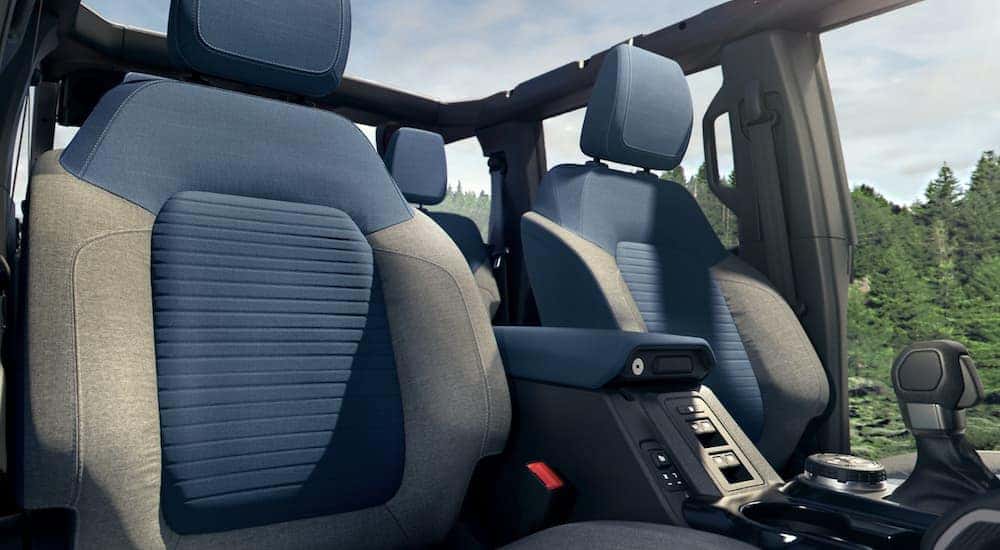
The first-generation Bronco offered a range of capability that many drivers had never considered before. The Roadster was considered the base trim, and its roof and doors were offered as options instead of standard equipment. This was the inspiration for today’s Broncos “doors off, roof off, let nature in” approach to driving. The Sports Utility version included a bench seat half-cab and came equipped with a pickup truck-style bed for hauling tools, equipment, and more. The Wagon version included a solid roof, two doors, and a rear bench seat, offering a spot for up to five passengers to enjoy the ride.
While the newest generation of Bronco offers up to 300 or 330 horsepower, depending on the engine selected, its ancestors relied upon a 6-cylinder engine that offered 105 horsepower. Not to worry, however, a V8 was soon added to the lineup and became one of the Bronco’s hallmarks, along with its standard 4-wheel drive.
So what could someone do with their new 1966 Ford Bronco? According to advertising of the day, anything you want. Available accessories included winches, tow hooks, a more powerful acceleration system, and more. Drivers were suddenly able to explore the roadways and the wilderness equally, thanks to this new SUV concept.
The SelectShift Cruise-O-Matic 3-speed transmission came on the scene in 1973, along with power steering. The engine grew a bit to allow for greater power and performance. However, this Bronco was just in time for the 1970s oil embargo and federal requirement for less fuel consumption. Due to the continuing economic crisis, drivers were encouraged to spend as little time as possible driving, and many small car manufacturers jumped into the spotlight with their fuel-friendly vehicles. This was not the time for the Bronco to shine, and Ford waited patiently for its return to the spotlight.
Therefore, when the Bronco returned to markets, it was better than ever. Using the F-Series truck platform, the 1978 Bronco was longer and wider and engineered inside and out to provide an even more comfortable ride. The seats were deeper, legroom was more abundant, and drivers could even select AM/FM radios and air conditioning for the very first time.
As time passed, the Bronco’s designers kept up with what drivers required of their off-road vehicle, aided by current technology and engineering updates. The third generation, which ran from 1980 to 1986, was smaller and more fuel-efficient, thanks to lighter materials and a greater appreciation of aerodynamics. The fourth generation, available from 1987 to 1991, included electronic fuel injection and rear anti-lock brakes. The fifth, initially presumed the final generation, was given airbags and 3-point safety belts.
In total, 1,148,926 Broncos were manufactured between 1966 and 1996. While not all survived the test of time, a few notable Broncos made it into the history books.
The Bronco Proves Itself to the Public
Did you know that the Bronco is actually a very famous vehicle? Both on the streets and in competition, the Bronco has proven itself time and time again.
Ford knew that the first generation Bronco had to be able to stand up to the hype, so they gave one to off-road legend Bill Stroppe, who collaborated with the manufacturer on many performance-oriented cars throughout his lifetime.
Little did anyone realize, Stroppe would become completely enamored of the Bronco. The first model he was given took the winner’s spot at the 1967 Riverside Four-Wheel Drive Grand Prix and served as inspiration for the first Bronco Roundup. After encountering some difficulties during the first Baja 1000 in 1967, Stroppe made some important recommendations to Ford regarding the vehicle’s performance. As a result, Stroppe-campaigned Broncos returned and won the 1968 Baja 1000, along with the Mint 400 and Riverside in the same year.
Perhaps the most famous Stroppe Bronco was Parnelli Jones, famed Indianapolis 500 driver. His 1969 modified Bronco, known as “Big Oly,” became a superstar in the off-road world, winning the 1971 Baja 1000, 1972 Baja 1000, 1973 Baja 500, and 1973 Mint 400. With a chrome moly frame, a 390 horsepower V8 engine, and custom suspension system, Big Oly showed the world what a Bronco could do. The vehicle that once famously drank gasoline from a tequila bottle sold at a Mecum auction in 2021 for an impressive $1.87 million.
But the Bronco saw service on the roads, as well. Wearing its finest Wimbledon White exterior, Pope John Paul II waved to thousands of fans and spectators during his October 1979 stadium tour of New York City. The Pope stood proudly in the truck’s open bed, which was equipped with a handrail, and waved at those who came to greet him. Three Broncos, dubbed “Popemobiles” by the press, were used throughout his US visit. As a result, many continue to refer to open Broncos as “Popemobiles” to this day.
Honoring Its Heritage: Today’s Ford Bronco
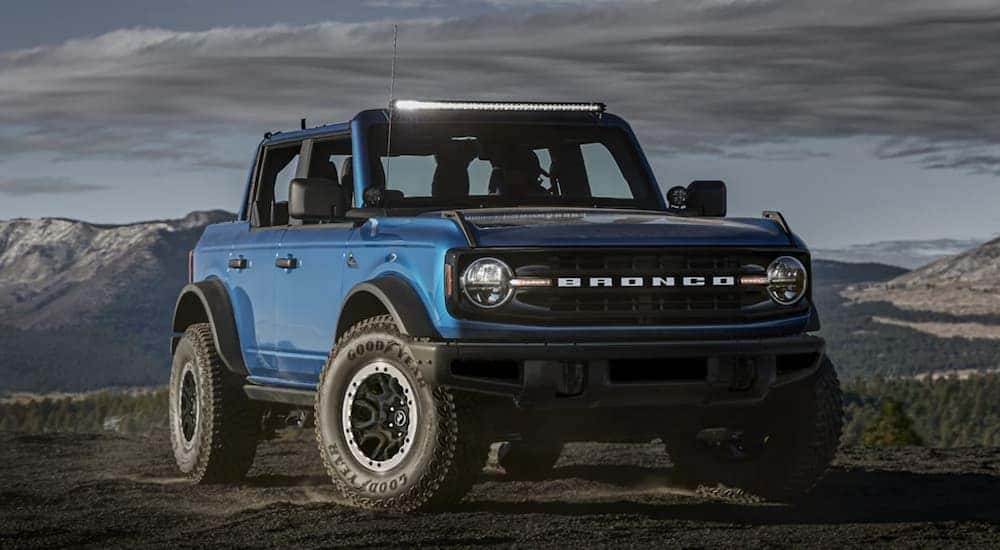
Today’s Ford Bronco takes many cues from its predecessors. The overall cube-like shape, the drainable interior, and even its grille and headlights are reminiscent of the first-generation Bronco.
However, this is a new day and age, and drivers have many choices for off-road-ready exploration vehicles. Still, there are many compelling reasons to choose the Ford Bronco or Bronco Sport over the competition. The Bronco has been purposefully built and fine-tuned over the years to provide drivers with the most adventure and fun without sacrificing comfort and convenience. While we’re certainly a long way from the days in which air conditioning was considered a luxury, today’s Bronco has all the features modern drivers require, such as Bluetooth connectivity and a fantastic audio system.
The Bronco was born from the idea that people should drive precisely the right vehicle for what they want and need, and the rebirth of the Bronco only goes to prove that proposition.

0 comment(s) so far on From Mustang to “Goes Over Any Type of Terrain”: The Legend of the Ford Bronco